
Genius for Restaurants
Start for $0. Seriously.
An offer this good? It’s Genius. No subscription, no setup cost, no hardware bill. We build your menu before we travel, run the go live in person, and support the system around the clock afterwards.
How it works, in three steps
1. Post your pricing
Your listed prices include the card processing cost, and you display clearly that cash customers receive a discount.
2. Discount at the register
A guest pays cash, the system removes the fee amount, and the discount appears as its own line on the receipt.
3. Cards run normally
Card-paying guests pay the listed price. Nothing about their experience changes.
Why restaurants do it
It protects margin you already earned
Processing costs come off the top of every card sale. This is the rare lever that moves without touching food cost or labor.
Cash gets you paid immediately
No settlement wait, no chargebacks, no fraud exposure on cash tickets.
Guests understand it
Framed as a reward for cash rather than a penalty for cards, it lands fine — we will help you word the signage.
Small tickets hurt the most
Most processors charge a percentage plus a flat fee per swipe, so a night of appetisers and drinks costs you more in fees than the same money on fewer, larger checks.
What it looks like on a $20 check
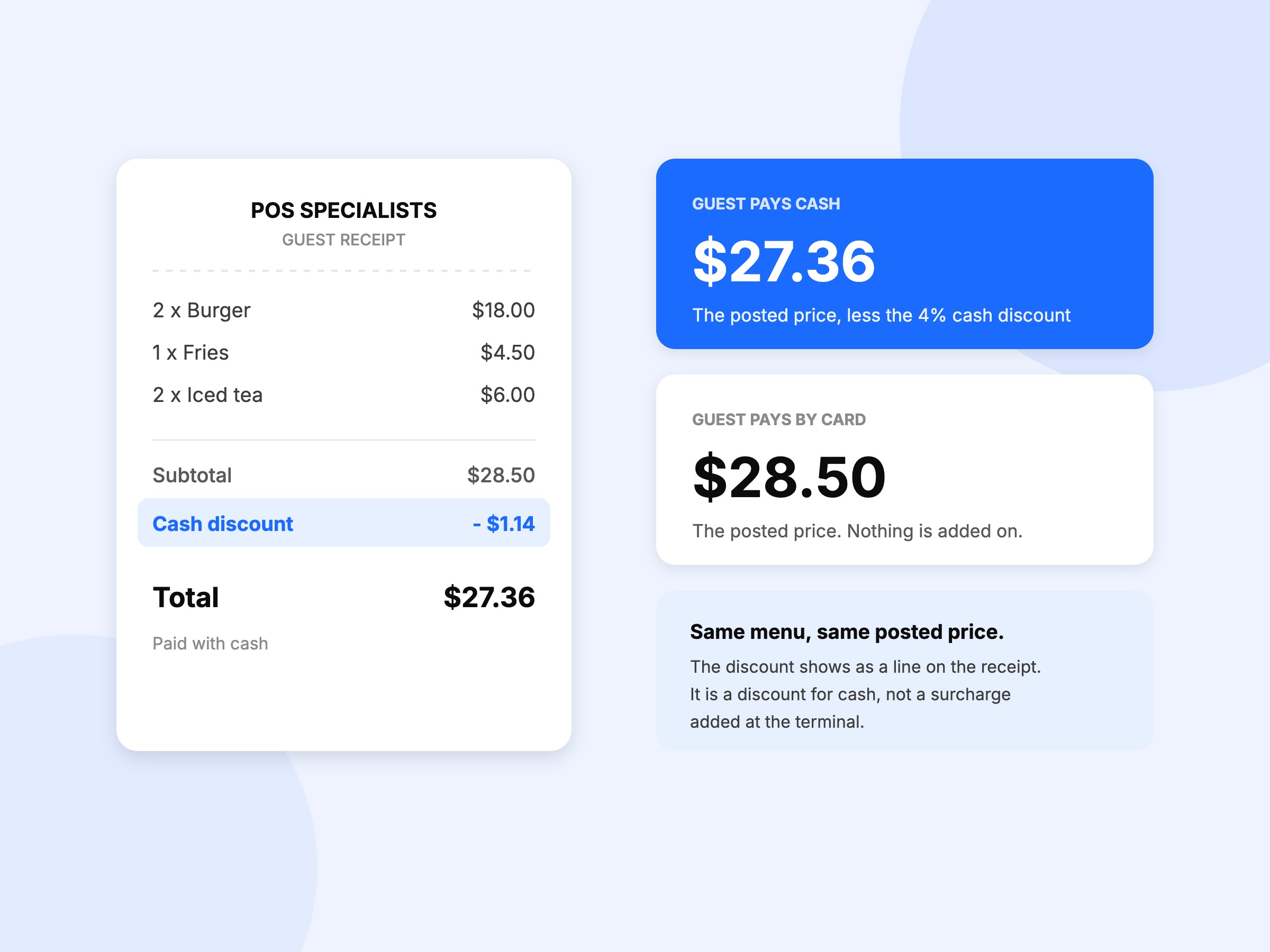
Same check, two ways to pay. The numbers below are an illustration — your discount percentage is set with you when we build the program.
Menu price $20.00
What every guest sees before they order. The card processing cost is already built into it, which is the whole reason this is a discount and not a surcharge.
Paying cash $19.30
The register takes the discount off the entire check and prints it as its own line. The guest sees it on the customer-facing display before they hand over the money, not after.
Paying by card $20.00
Exactly what the menu said. Nothing gets added at the terminal, and the processing cost on that sale is already covered.
Illustration only, shown at a 3.5% discount. Your actual percentage should reflect what you are really paying to process cards, and we work that out with you before anything is repriced.
Cash discount, not surcharge
People mix these up constantly, and the difference matters. A surcharge adds a fee on top of the price when a guest pays by card. A cash discount takes a percentage off the posted price when they pay cash.
Surcharge
- Guest pays the posted price plus a fee for using a card
- Prohibited outright in several states
- Capped at 4% of the transaction in the US
- All card brands have to be notified before you start
- Often needs a lawyer to confirm your city or state allows it
Cash discount
- Guest pays less than the posted price when they pay cash
- Not prohibited in any state
- No cap, because nothing is being added
- No card brand notification to file
- Signage at the door and register, disclosed before payment
Rules change and vary by state. We keep an eye on it, but confirm anything that affects your business with your own attorney.
Staying compliant
Build fees into pricing
The listed price includes the processing cost — that is what makes it a discount rather than a surcharge.
Disclose before checkout
Clear signage at the door and at the register, before the guest commits to the order.
Show it on the receipt
Apply the discount to the whole invoice and print it as its own line item.
We will set the whole thing up
Program design and the discount percentage, repricing your whole menu in one bulk update instead of item by item, POS and receipt configuration, signage, and staff training. Call 925-626-3930.