
Every vendor at every trade show is selling AI to restaurants right now. Very few of them will tell you how few restaurants are actually using it, or which parts are ready and which parts are still a science project.
We install and support Point of Sale systems in Northern California, and we have been putting AI tools in front of real operators for long enough to know where they hold up on a Friday night and where they do not. This is the straight version: what restaurant AI actually means, what it is worth today, and what to ignore for now.
Written by Alex Ugrin, Partner at POS Specialists, with Brad Brockman, Chief AI Officer.
How many restaurants are actually using AI?
About a quarter of them. In the National Restaurant Association’s State of the Restaurant Industry 2026 report, 26% of operators said they use AI related tools in their restaurants. The breakdown matters more than the headline:
- Marketing is the leader. 19% of full service operators and 15% of limited service operators use AI to help with marketing.
- Admin is second. 10% use it for at least some administrative work.
- Ordering is barely started. Only 6% use AI for customer orders, despite every drive-thru voice headline you have read.
- The money is coming. Six in ten operators plan to invest more in technology to improve the guest experience.
- Most operators think they are average. 60% say their technology is roughly in line with competitors. 28% say they are lagging. Only 12% call themselves leading edge.
Read that last line again. Nearly a third of restaurants know they are behind. If you are one of them, you are not late to something everyone else has figured out. You are early to something most people are still circling.
Source: Restaurant Dive’s coverage of the National Restaurant Association 2026 report.
What “restaurant AI” actually means
The term covers at least five different things that have almost nothing to do with each other. Lumping them together is why the conversation gets muddy.
- Marketing AI writes your posts, segments your list and decides who gets which offer.
- Voice AI takes an order out loud, at a table, a drive-thru or over the phone.
- Reporting AI answers questions about your own sales data in plain language.
- Operational AI forecasts prep, flags waste and helps with scheduling.
- Guest facing AI powers kiosks, recommendations and upsell prompts.
They mature at different speeds, they cost wildly different amounts, and they fail in different ways. A restaurant that says “we tried AI and it did not work” has almost always tried exactly one of these five.
The five places AI earns its keep right now
1. Marketing, because the alternative is nothing
This is the top use for a reason. Most independent restaurants do their marketing at 11pm on a Sunday or not at all. AI does not have to be brilliant to beat that. It has to be consistent.
The version that works is tied to your actual sales data, so the offer that goes out on a slow Tuesday is aimed at people who have not been in for six weeks, not blasted to everyone. That is what our AI marketing setup does.
2. Answering the phone
The phone is the most ignored revenue leak in the business. It rings during the rush, nobody picks up, and that order goes somewhere else. Nobody logs it, so nobody fixes it.
Phone answering is the easiest AI win we deploy, because the bar is low and the failure mode is graceful. If the AI cannot handle it, it hands off to a human. It never does worse than a phone ringing out. See AI phone answering.
The restaurants getting value out of AI right now are not the ones who bought the most AI. They are the ones who picked one job that was eating their week and handed that one job over.
Brad Brockman, Chief AI Officer, POS Specialists
3. Reporting you can just ask a question
Every Point of Sale has reports. Almost nobody reads them, because getting an answer means knowing which report to open and then exporting it to a spreadsheet.
AI reporting removes that step. You type the question the way you would say it out loud, and the answer comes back with the chart already drawn. “Which menu items are driving the most revenue?” “What were my sales on St. Patrick’s Day last year?” This is the lowest risk AI in a restaurant, because it only reads. It does not touch a ticket, a price or a guest. Genius AI reporting is built into the back office and is available to restaurants on Genius at no additional cost.

4. Voice ordering at the table
This is the one that is genuinely new. A server has a real conversation with the table while the handheld listens and builds the ticket in the background, including modifiers and the change somebody makes halfway through.
It needs hardware that can think. The AI-first Genius handheld runs neural processing on the device instead of waiting on the cloud, and carries multiple built-in microphones specifically so spoken order entry holds up in a loud room. That is not a software upgrade you can push to a five year old terminal.

5. The counter and the kitchen
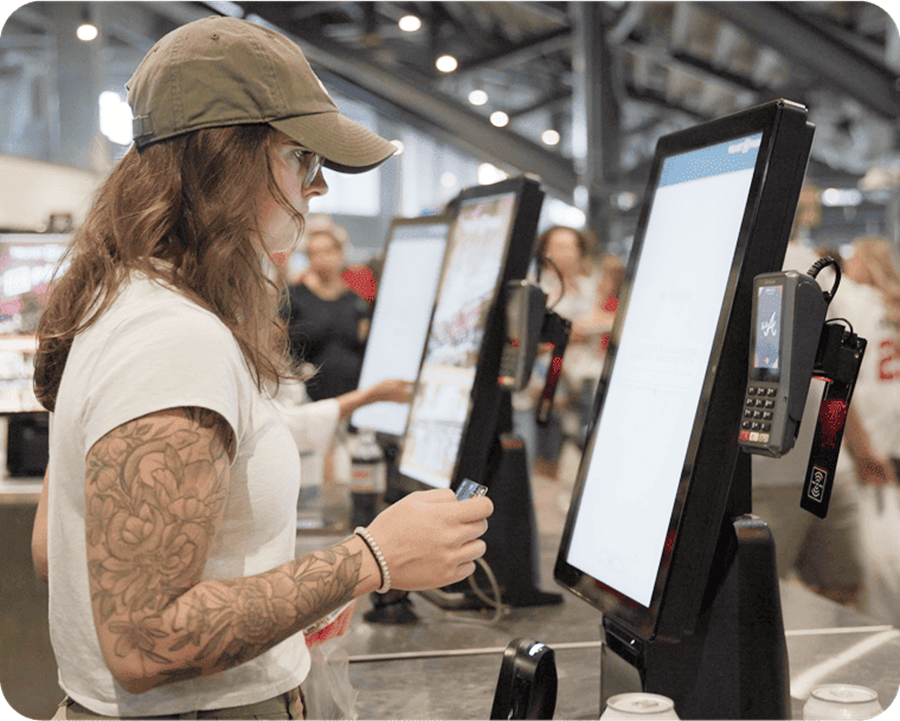
Self-service is where AI quietly earns money, because a kiosk upsells the same way every single time and never gets embarrassed about it. Behind the line, a connected kitchen display routes and times tickets so the food goes out together.
Where restaurant AI still falls down
Anybody who tells you this is all solved is selling something. Two of the biggest names in the business have publicly pulled back on drive-thru voice AI. McDonald’s ended its drive-thru voice partnership with IBM in 2024 after three years. Taco Bell, which expanded voice AI across hundreds of US locations, rethought its rollout after inconsistent performance.
Those are companies with budgets you do not have. The lesson is not “avoid AI.” It is that the drive-thru is the hardest possible environment, and it is not where a single location should start.
The failure we see most often is much more boring than a robot misunderstanding a customer. It is bad data underneath.
AI is only as good as the menu underneath it. If your modifiers are a mess, the AI inherits the mess and then confidently gives you a wrong answer. Half of what we do before switching anything on is cleaning up the build.
Brad Brockman, Chief AI Officer, POS Specialists
If your item names are inconsistent, your modifiers are duplicated, and half your sales ring in on a miscellaneous button, no amount of AI will save you. It will just be wrong faster.
How to tell if your restaurant is ready
Five honest questions. If you cannot answer yes to the first three, fix those before you buy anything.
- Is your menu built correctly in your Point of Sale? Clean items, clean modifiers, nothing ringing in on a generic key.
- Is your data in one place? If online ordering, delivery and in-house sales live in three systems that do not talk, AI has nothing coherent to read.
- Do you know which problem you are solving? “We should do AI” is not a problem. “We miss forty phone calls a week” is.
- Can your staff be trained on it in one shift? If it needs a manual, it will not survive your turnover.
- Do you know who to call when it breaks? This is the one people skip, and it is the one that decides whether the tool is still running in six months.
What we are building
We have been doing this since 1991, which means we have watched a lot of restaurant technology arrive with enormous promises and leave quietly. We treat AI the same way we treated tablets, online ordering and kiosks: prove it on a real floor first, then recommend it.
Brad Brockman runs that work as our Chief AI Officer. His job is to separate what demos well from what survives a Saturday night, and to get the underlying build right so the AI has something reliable to work with.
The real shift is that the AI is moving into the Point of Sale itself instead of sitting in a separate app nobody remembers to open. That is the part operators will actually feel, because it shows up in the tools they already touch a hundred times a shift.
Brad Brockman, Chief AI Officer, POS Specialists
If you want to see what any of this looks like pointed at your own menu and your own numbers, that is a conversation, not a pitch deck. Call 925-626-3930 or get pricing, and you will get a person who can name your restaurant.
Restaurant AI questions, answered
Is AI worth it for a small independent restaurant?
Yes, but only one piece of it at a time. Marketing and phone answering pay for themselves fastest at a single location because they replace work that is currently not getting done at all. Voice ordering and kiosks make more sense once volume justifies the hardware.
Will AI replace my staff?
Not in any restaurant we work in. What it replaces is the data entry part of the job. A server taking an order by talking instead of tapping through screens is still the person delivering the hospitality. The realistic outcome is the same staff handling more covers with less friction, not fewer staff.
How much does restaurant AI cost?
It varies enormously by category, which is why nobody publishes a number. Some of it is included: Genius AI reporting is available to restaurants on Genius at no additional cost. Voice ordering requires the AI-first handheld. Marketing and phone answering are typically monthly. Call 925-626-3930 and we will tell you what applies to your setup rather than quoting you a package you do not need.
Do I need new hardware for AI voice ordering?
Yes. Voice ordering needs the AI-first Genius handheld, because the neural processing and the microphone array that make it work are in the device itself. AI reporting, by contrast, runs on what you already have.
What is the easiest place to start with AI in a restaurant?
Reporting, because it only reads your data and cannot break anything, or phone answering, because its worst case is no worse than an unanswered phone. Both give you a real result inside a week without retraining your floor.
Can AI take orders over the phone?
Yes, and it is one of the more reliable uses because a phone call is a controlled audio environment compared to a drive-thru speaker. The order drops into your Point of Sale like any other. A human takes over when the call goes off script.
Why did McDonald’s and Taco Bell pull back on voice AI?
Both were running drive-thru voice at large scale, which is the hardest environment there is: engine noise, wind, accents, background passengers and no visual confirmation. Performance was inconsistent enough that both reconsidered. Table-side and phone voice ordering are meaningfully easier problems, which is why they are working while the drive-thru is still being figured out.
Where to go next
- Genius AI: AI reporting and voice ordering inside the Point of Sale
- AI phone answering: stop losing the calls you miss during the rush
- AI marketing: offers aimed at the right guests, automatically
- Genius for Restaurants: the platform the rest of it runs on
- Why us: who you actually get on the phone